
AI initiatives don’t become production-ready simply because an organization has governed data and access to capable models. AI initiatives actually become scalable when the underlying data platform can enforce access controls, withstand failures, deliver predictable performance, provide operational evidence, and connect consumption to business value. That’s why data platforms need their own well-architected framework.
Infrastructure architecture remains essential, of course, but it doesn’t fully address the unique challenges of governed data products, retrieval-augmented generation (RAG), semantic models, AI agents (agents), cross-domain sharing, policy enforcement, and consumption-based platform economics.
Announced late 2025, Snowflake addressed this need with the release of its Snowflake Well-Architected Framework (WAF). The framework, together with its assessment and implementation guidance, provides a platform-native blueprint for evaluating and continuously improving those outcomes.

Rather than treating architecture as a one-time design checkpoint, Snowflake WAF helps organizations establish a repeatable operating model for data, analytics, applications, and AI. The framework is organized around five interconnected pillars: Security and Governance, Operational Excellence, Reliability, Performance Optimization, and Cost Optimization.
The Snowflake WAF can also be evaluated through two cross-cutting lenses: an AI and data governance lens and an open and interoperable lens. These lenses extend the five pillars to address governed AI, policy enforcement, open data ecosystems, and integration across enterprise environments. Before we explore the details of the framework, let’s first consider why it’s necessary.
The gap in generic guidance
It’s important to understand how the Snowflake WAF differs from traditional frameworks. Traditional well-architected frameworks are often rooted in infrastructure questions and implementation details:
- Is the application highly available?
- Are compute resources provisioned appropriately?
- Is network access restricted?
- Are backup and disaster-recovery plans in place?
- Are costs monitored and controlled?
Those questions still matter. However, a modern data and AI platform introduces a unique set of architectural questions:
- Can users, applications, and agents access only the data they are authorized to use?
- Are row-level, column-level, privacy, and policy controls carried through data products and AI experiences?
- Can a business user trust that a metric, document, semantic definition, or agent response is grounded in approved enterprise data?
- Can teams see what an agent retrieved, which tools it called, how it formed a response, how long it took, and what it cost?
- Can teams attribute data and AI consumption to a business unit, product, project, customer, or value stream?
- Can data move across systems and clouds without losing governance, lineage, reliability, or accountability?
Addressing these architectural concerns is necessary for a data platform to operate as a trusted foundation for analytics and AI at enterprise scale. The Snowflake WAF, a platform-native framework, translates broad architecture principles and best practices into effective guidance and decisions involving data access, workloads, platform operations, governance, resilience, performance, and cost.
An AI-ready foundation
The quality of the underlying data foundation is a critical factor in whether an organization’s AI initiatives can scale safely, reliably, and economically. And it’s important to remember that building an AI-ready platform requires more than storing governed data or connecting an AI model to a retrieval service. It requires an architecture that consistently applies security controls and performance engineering while also supporting operational visibility, cost accountability, and resilience practices.
Consider a sales or customer-success agent that helps account teams prepare for upcoming account renewal conversations.

To provide a response, the agent may need to combine:
- Structured account, product-usage, and opportunity data
- Governed definitions of renewal risk, customer health, and revenue metrics
- Semantic models or semantic views that guide business-language questions
- Unstructured content such as contracts, account plans, support notes, and meeting summaries
- Search retrieval services that identify relevant documents or content chunks
- Tools that execute queries, retrieve content, or initiate approved downstream actions
A traditional approach to architecture won’t satisfy these conditions. What’s needed is a data platform workload with identity, authorization, data-quality, retrieval, performance, observability, reliability, and FinOps requirements.
If an agent retrieves restricted content, the issue can’t be solved by just suppressing a sensitive phrase in the final response. Authorization must determine what can be retrieved and placed into the agent’s context in the first place.
If the agent produces inconsistent responses, teams need the ability to trace its planning, tools, retrieved evidence, latency, and outcomes. If usage expands from a pilot group to thousands of employees, or if agents begin operating asynchronously, the workload’s concurrency profile and cost behavior could change dramatically.
Snowflake’s Cortex Agents documentation describes how data access is governed by existing Snowflake roles, privileges, and the execution context of each configured tool. A request is rejected when the user’s role lacks the necessary tool privileges. This illustrates a core AI-ready architecture principles: access control must apply to the complete action path, not merely to the user interface that initiates a prompt.
The five pillars
The Snowflake WAF organizes architectural evaluation around five interconnected pillars. The pillars should not be interpreted as separate checklists. In practice, every meaningful architecture decision involves trade-offs across security, operational maturity, reliability, performance, and cost.

Snowflake’s AI and data governance lens recognizes that the five core Snowflake WAF pillars require more specific controls when data and AI workloads are involved.
Security and Governance: Protect confidently
The Security and Governance pillar establishes the conditions under which data, models, applications, and agents can be trusted. This includes identity and access management, role design, least privilege, network protections, data classification, data masking, row-access policies, privacy controls, lineage, monitoring, and audit evidence.
A practical design goal is to make authorized behavior the default architecture rather than an outcome that depends on every individual developer, analyst, or agent creator remembering to implement a custom safeguard.
Operational Excellence: Run intelligently
The Snowflake Operational Excellence pillar asks whether teams can operate the architecture deliberately, consistently, and transparently. A production data platform needs more than successful deployments. It needs shared operating practices for changes, telemetry, incident response, recovery, testing, optimization, and continuous improvement.
AI observability is especially important because AI systems can fail in ways that are difficult to diagnose from a final response alone. Snowflake’s AI Observability capabilities are designed to help teams investigate individual production requests, evaluate AI quality against test data, understand workload cost, and review guardrail behavior. For Cortex Agents, Snowflake also provides agent-request monitoring with conversation history and execution traces that can include planning, tool calls, responses, and user feedback.
This moves observability beyond “did the agent return an answer?” Teams can examine whether the agent selected appropriate tools, used the correct data path, met latency expectations, stayed within cost expectations, and behaved consistently with policy.
Reliability: Design for continuity
Reliability is not limited to whether the data platform itself is available. It includes whether the broader workload can continue to produce correct, timely, and recoverable outcomes when components fail, dependencies change, data arrives late, upstream systems degrade, or users generate unexpected demand.
Reliability must also cover the integration surface. Snowflake’s Open and Interoperable Lens extends reliability beyond database availability to include multi-engine access, Apache Iceberg, external catalogs, data sharing, change-data-capture patterns, and portability across the Snowflake ecosystem.
This is an important distinction for enterprise architects. A Snowflake environment may be healthy while an AI experience is still unreliable because a document ingestion process failed, a semantic definition changed without review, a source-system feed became stale, or a downstream tool dependency is unavailable.
Reliability therefore requires end-to-end thinking: trusted data, dependable transformations, governed access paths, observable execution, recovery processes, and well-defined degradation behavior.
Performance: Deliver predictably
Performance optimization is about more than making a query run faster. It is about delivering predictable outcomes for different workload types while balancing concurrency, responsiveness, resource isolation, data-access patterns, and cost.
AI changes the nature of these workloads. A traditional analytics environment may have predictable peak periods and well-understood dashboards. Yet, an agentic environment can introduce:
- Unexpected activity bursts which results in less predictable user demand
- Multi-step reasoning and tool invocation
- Repeated retrieval and query activity within a single interaction
- Mixed workloads across pipelines, BI, applications, search, and agents
- New patterns of interactive and asynchronous execution
- Higher sensitivity to user-perceived latency
Teams should establish performance objectives for each workload category instead of relying on broad assumptions that the platform will automatically adapt to every condition. The point is not to optimize every workload to the same standard. It is to make performance expectations explicit and measure whether the architecture meets them.
For example, an account-planning agent that supports a live customer meeting may need a low-latency path to curated account metrics and approved documents. A nightly agent-based review of renewal risk may be more tolerant of longer execution but require stronger controls for throughput, failure handling, and cost. Treating both workloads the same produces a weaker architecture.
Cost Optimization: Spend with purpose
Cost optimization in a modern data platform cannot be limited to reducing compute size or applying auto-suspend settings although those are useful tactics. However, a mature FinOps practice connects consumption to workload purpose, accountable owners, expected outcomes, and measurable business value.
Snowflake provides usage and budget-management capabilities that can help organizations monitor AI-related consumption, track spend, and define actions when configured spending thresholds are reached. For example, CoWork resource budgets can monitor spend and take actions when thresholds are exceeded. AI Observability can add request-level context for investigating AI workload behavior and cost.
This is particularly significant for AI agents. Cost may be driven not only by a model call, but also by the compound effect of search, retrieval, queries, multi-step tool use, retries, evaluations, and user demand. Visibility into the full execution path helps teams distinguish productive AI usage from inefficient or unintended activity.
Cross-cutting lenses
The five pillars provide the foundation, but AI-ready data architectures require two cross-cutting perspectives. AI and data governance, and openness and interoperability.
AI and data governance
AI and data governance should be presented in every architecture decision. It influences how data is classified, how policies are applied, how semantic definitions are governed, how retrieval is constrained, how outputs are evaluated, and how agent activity is reviewed.
For example, consider a RAG assistant that helps employees locate internal policies and procedures. If content is segmented and indexed without respecting access boundaries, an unauthorized document might be retrieved into the model’s context even if the final response is later filtered. The stronger design is to align corpus segmentation, search-service access, roles, object privileges, row and column protections, and tool execution so that unauthorized material is never eligible for retrieval.
Snowflake CoWork agents can use semantic views, semantic models, Cortex Search services, and tools while inheriting existing Snowflake governance controls, including row-access policies and column-level security. This supports an architecture principle that is especially important for enterprise AI: policy enforcement should be embedded in the data and tool paths that agents use.
Openness and interoperability
Enterprise data foundations rarely operate as isolated systems. They span cloud environments, operational applications, external data providers, data-sharing relationships, open table formats, BI tools, notebooks, application frameworks, and agent ecosystems.
The openness and interoperability lens asks whether the architecture can evolve without creating unnecessary lock-in, fragmented governance, duplicated data, or brittle custom integrations. It also asks whether reliability, security, lineage, and operational accountability are maintained as data moves across boundaries.
This doesn’t mean every workload must use every open technology. It just means that architectural choices should be intentional. Teams should understand where data resides, which systems can access it, how schemas and semantics change, how policies apply, and how failures or changes propagate across the integration surface.
From architecture review to operating model
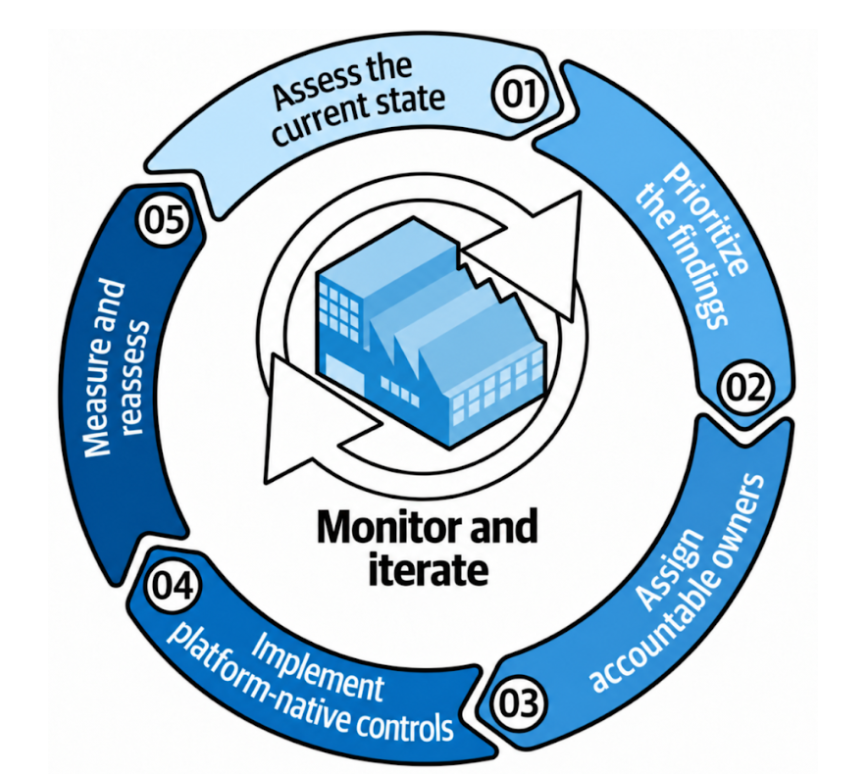
The most important important shift in the Snowflake WAF is conceptual. Architecture shouldn’t be a one-time event that only happens before a deployment. Instead, architecture for an AI data platform should be a continuous improvement practice.

Here’s an example of a lifecycle approach for architecture continuous improvement.
- Assess the current state
Evaluate critical workloads against the five pillars and the AI / data governance and interoperability lenses. Identify both design gaps and operational gaps. - Prioritize the findings
Not every improvement has equal urgency. Prioritize issues based on risk, regulatory exposure, business criticality, user impact, cost exposure, and implementation effort. - Assign accountable owners
A well-architected platform requires shared responsibility across data engineering, platform engineering, security, governance, application development, AI engineering, and FinOps. Each action should have an accountable owner and measurable outcome. - Implement platform-native controls
Translate findings into roles, policies, tagging standards, monitoring, budgets, workload configuration, data quality checks, deployment processes, recovery plans, and observability practices. - Measure and re-assess
As data products, agent capabilities, user populations, and consumption patterns evolve, reassess the architecture. New workloads introduce new dependences and risks; controls that were sufficient for a pilot may not be sufficient for enterprise adoption.
Snowflake’s recent WAF guidance describes this operationalization of continuous improvement through automated assessments, prioritized opportunities, and detailed findings. The direction is clear: use architecture guidance to produce actionable improvement work, not just a static scorecard.
Questions for every workload
Before deploying or expanding a data, analytics, application, or AI workload, enterprise teams should be able to answer foundational questions for each pillar.

For AI workloads, there are two additional questions:
- Can the organization trace how the agent arrived at an answer or action, including the tools and governed data paths it used?
- Can the organization scale agent usage without losing control or authorization, quality, operational reliability, or cost?
Architect once, evolve continuously
The purpose of the Snowflake Well-Architected Framework is not to declare a data platform permanently complete because enterprise platforms are continuously changing. Data domains expand, user populations grow, policies evolve, source systems change, AI capabilities mature, and operating assumptions are tested by real workload behavior.
The value of WAF is that it gives data, AI, security, platform engineering, and FinOps teams a common language for making these changes responsibly. It also helps them turn broad principles into observable controls, measurable trade-offs, accountable actions, and a repeatable improvement cadence.
For organizations building AI-ready data foundations, that shift in thinking truly matters. It’s important to consider whether the entire architecture can support trusted, governed, resilient, performant, and economically sustainable AI at scale. Snowflake WAF provides a relevant framework for addressing that concern today and for the future as the platform and its AI workloads continue to evolve.
Leave a Reply