
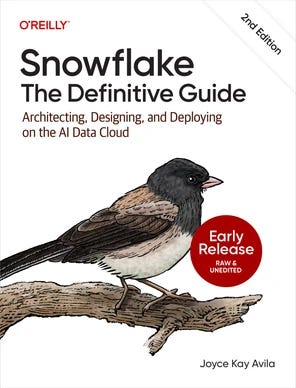
My journey to complete the second edition of the Snowflake Definitive Guide book continues! Currently, two chapters are available on the O’Reilly learning platform.

Chapters for the Snowflake Native App Framework and Built-in Data Governance and Discovery were first posted in October 2025 and new chapters on the platform will be arriving over the next several months.
Snowflake Native App Framework
The chapter explores how providers build Snowflake native apps and deploys them to the Snowflake Marketplace. In addition, there’s information about how a consumer installs a native app in their Snowflake environment. The chapter contents include:
- App Deployment Model
- Snowflake Native App Framework
- Hands-on: How the Native App Process Works
- Building Snowflake Native Apps
- Deploying Snowflake Native Apps
- Installing and Uninstalling a Native App
Built-in Data Governance and Discovery
The chapter about data governance is a very important one. I’ve included lots of information about Snowflake’s built-in capabilities for data governance and discovery.
- Horizon Catalog Framework
- Knowing Your Data: Object Tagging
- Know Your Data: Sensitive Data Classification
- Know Your Data: Data Metric Functions
- Protect Your Data: Column-Based Security
- Protect Your Data: Row-Level Security
- Unlock Data Value: Universal Search
The Book’s Artifacts
The book includes several diagrams to help explain concepts. As with all my books, I’ve included an abundance of diagrams and screenshots. For example, this diagram shows how a native app database is accessed by the consumer within their own Snowflake environment via the Snowflake Marketplace.

I’ve also made use of tables like the one below where I’ve listed the system-defined data metric functions. Something very interesting to note is that since this information was posted on the O’Reilly learning platform in October 2025, many more system-defined DMFs have been added by Snowflake.

As you would expect, I continually go back to update previously written chapters with new information as I work on additional chapters.
In addition to images and tables, I make generous use of code throughout the book. This helps to illustrate concepts in a different way because readers can use the code to experiment in a Snowflake environment themselves.

Of course, the contents of the book are ever-changing as the Snowflake platform continues to evolve. Naturally, there will be content about Snowflake AI and ML including Snowflake CoWork, Snowflake CoCo (formerly Cortex Code), Cortex Agents, Cortex AI Functions, Cortex Analyst and much more!
The Contributions of Technical Reviewers
As you can imagine, a definitive guide book covers a wide breadth of information and I’m relying on a number of technical experts to provide feedback as I create the chapter contents. The first batch of chapters will be sent to reviewers before the end of 2026 as we all work together in our efforts to get the book published with the most accurate and complete content.
There’s enough material (Snowflake keeps innovating so fast!) that I could write an endless amount of material. However, I do have a page count limit so that’s always something that I keep in mind when deciding how to much to focus on any one topic.
People have been asking for a second edition of the Snowflake Definitive Guide book for awhile now. For everyone who has inquired, I appreciate your patience while I write (and re-write) the chapters. I’m really excited to get the book out into the world as soon as possible.
Two chapters of the O’Reilly Snowflake Definitive Guide book written by Joyce Kay Avila (me!) are available now on the O’Reilly learning platform.
Early release chapters gives readers access to the raw and unedited content as the author writes it. This allows you to take advantage of learning about the technology long before the official book release. Content in the early release chapters is subject to change as the author re-writes the chapters based on technical reviewer’s feedback, upates to the technology platform, and editors’ revisions.
Leave a Reply