
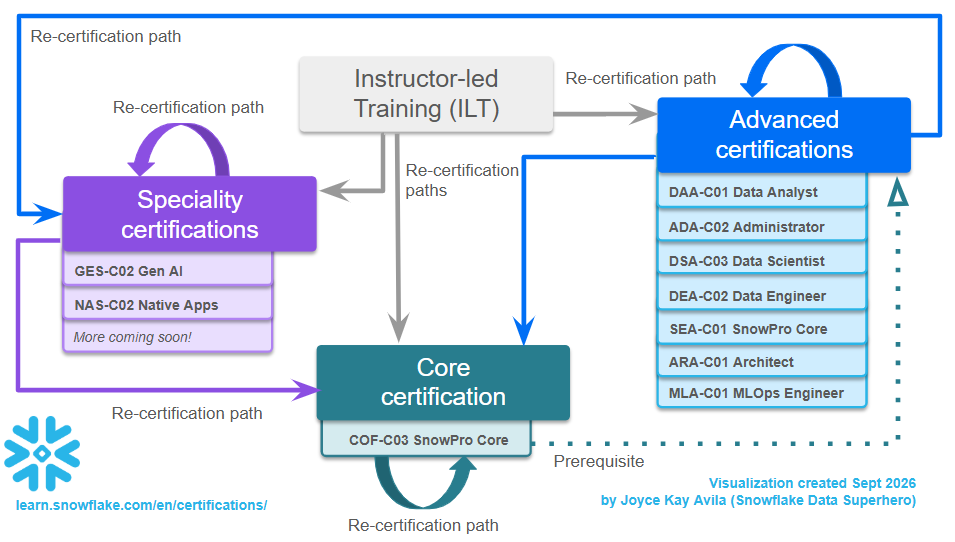
Snowflake’s certification program is not just a list of exams. Instead, it’s a set of domain-based and role-based pathways across the Snowflake AI Data Cloud. And it’s important to know that Specialty exams, based on specific Snowflake products and features, now have no prerequisites.

Often, people ask “Which Snowflake badge should I collect first?” Really, though, it’s probably better to think in terms of capabilities such as platform fluency, specialized product or feature skills, and advanced role-based responsibilities. A better question might be “Which capability do I want my Snowflake certification to demonstrate?”
Three levels, each with a different purpose
Today’s Snowflake certifications are classified as either Core, Specialty, or Advanced. Note that all exams use a scaled passing score of 750.

The distinction between Snowflake certification types matters. SnowPro Core is broad, covering a breadth of topics. SnowPro Specialty is targeted, and SnowPro Advanced certifications are persona-based. The different offerings provide more flexibility, rather than a simple linear ladder approach, for the certification program.
For example, someone working with Snowflake Cortex features or building Snowflake Native Apps can pursue the matching Specialty exam without first earning the SnowPro Core certification. However, a Snowflake practitioner must first earn the SnowPro core certification if they’re wanting to validate their knowledge within an advanced operational role such as Administrator, Data Engineer, Data Scientist, or Architect.
Think about the outcome you want
Are you wanting to demonstrate a broad understanding of the Snowflake platform, validate Snowflake feature-specific knowledge or provide evidence of your Snowflake role-based knowledge.
Demonstrate a broad understanding of the Snowflake platform
SnowPro Core is the platform-wide starting point. It covers the Snowflake AI Data Cloud architecture, account and virtual warehouse management, loading and unloading data including transformations, performance monitoring and optimization, account management and data governance, and data collaboration. Its five weighted domains reveal what the certification is designed to measure.

The recommended background is foundational database and cloud knowledge including SQL terminology, tables and data types, selecting and manipulating data, views, stored procedures, functions, authentication and authorization, plus knowledge of cloud-computing concepts. SnowPro core is available in English, Japanese, Korean, French, and Spanish.
This is the credential for professionals who need to show they can speak the common language of the Snowflake platform, even if their eventual focus is administration, engineering, analytics, AI, or security.
Validate Snowflake feature-specific knowledge
The Snowflake Specialty certifications offer a different route: a focused credential that does not require SnowPro Core. This is especially relevant for developers or AI practitioners whose work involves a specific Snowflake capability. There are currently a few Snowflake Specialty exam options and several more coming soon.

The Gen AI exam is intended for work involving the Snowflake Cortex suite, including LLM-oriented capabilities such as Cortex Analyst, Cortex Search, and Cortex Code. It also addresses infrastructure, data governance, and cost governance, along with Snowflake Container Services and Snowflake Model Registry.
The Native Apps exam focuses on application architecture, manifests, setup scripts, application logic, security configurations, Marketplace deployment, installation and troubleshooting, and version-release workflows. Basic familiarity with Snowflake-supported languages such as Python and with application development lifecycle management is recommended for those considering taking this certification exam.
A Snowflake Specialty exam tests a practitioner’s knowledge about a specific Snowflake-domain. It’s not considered to be a lower-level exam. It’s a certification that just tests over a narrower amount of Snowflake material.
Evidence of advanced role-based knowledge
A valid SnowPro core certification is required to register for a Snowflake Advanced certification exam. These advanced exams are intended for practitioners whose responsibilities extend beyond general platform knowledge into the design, operation, governance, analysis, or delivery of production capabilities.

The Data Analyst certification exam’s largest domain is Data Analysis at 32%, followed by Data Presentation and Data Visualization at 28%. The remaining coverage is Data Transformation and Data Modeling at 23% and Data Ingestion and Data Preparation at 17%. This credential goes beyond querying. It validates the ability to prepare data, build and troubleshoot advanced SQL, work with built-in functions and UDFs, conduct descriptive, diagnostic, and predictive analysis, and present data in ways that meet business requirements.
The Administrator certification concentrates on operating and governing Snowflake. Its most heavily weighted domain is Snowflake Security, RBAC, and User Administration at 31%, followed by Performance Monitoring and Tuning at 20% and Account Management and Data Governance at 18%. It includes database objects and virtual warehouses, sharing and the Snowflake Marketplace, as well as disaster recovery, backup, and replication.
The Data Engineer certification validates the engineering work behind scalable data products. Its exam weights emphasize Data Movement at 28% and Data Transformation at 25%, with additional focus on Performance Optimization, Storage and Data Protection, and Data Governance. Recommended knowledge includes RESTful APIs, SQL, semi-structured and unstructured datasets, cloud-native concepts, and programming experience.
The Security Engineer certification is explicitly focused on data protection, privacy, governance, identity, compliance, risk, incident response, and AI/ML-related security. Its largest domain is Data Protection, Data Privacy, and Data Governance at 30%, followed by Access Control and Identity Management at 22%. The remaining domains cover auditing, monitoring, and compliance; threats, risk assessment, incident response, and forensics; and securing Snowflake services and features for AI, ML, and applications. Recommended knowledge includes general IT cloud security, data governance, and basic SQL and Python.
The Architect certification focuses on full data-flow and platform-architecture decisions from source through consumption, from technical design through business, security, and compliance requirements. It also includes tool selection, architecture performance, and shared dataset design using Snowflake Marketplace and Data Exchange. Its four domains are Snowflake Architecture at 30%, Account and Security at 25%, Data Engineering at 25%, and Performance Optimization at 20%. Coding experience beyond SQL and DevOps or DataOps design experience are recommended.
The Data Scientist certification covers Data Science Concepts, Data Preparation and Feature Engineering, Model Development, and Model Deployment. Model Development carries the largest weight at 31%, followed by Data Preparation and Feature Engineering at 27%.
The MLOps Engineer certification focuses on the production lifecycle around ML. This includes operationalizing data preparation and feature engineering, managing ML infrastructure, serving and deploying models, automating pipelines with CI/CD, and applying governance, security, and monitoring practices. Its heaviest domains are MLOps Infrastructure and Management at 24% and Pipeline Orchestration and Automation at 22%.
Recertification is part of the plan
A Snowflake certification is not a one-time milestone. Every Snowflake certification requires recertification every two years. The current recertification choices vary by certification category.

This creates a more flexible maintenance model than retaking only the same exam. A SnowPro Core holder can recertify by retaking Core or earning a Specialty or Advanced certification. The requirement can also be met by completing a Snowflake instructor-led training (ILT) course. Specialty holders can pass the same or another Specialty exam. Passing an Advanced exam or taking an ILT course also earns the Specialty holder another two years for the Specialty certification held. Advanced certification holders can recertify through an Advanced certification or an ILT course.
That flexibility supports a logical progression over time. For example, someone who earns SnowPro Core can later recertify by demonstrating specialization in Gen AI or Native Apps, or by earning an Advanced credential that reflects an evolved role. Someone holding an Advanced certification can maintain it through further Advanced certification activity or ILT training.
Build a deliberate path for yourself
A useful way to select a certification path is to match it to the work you want to make visible:
- Choose SnowPro Core when you want to demonstrate broad Snowflake platform expertise or when your target is an Advanced certification.
- Choose SnowPro Specialty: Gen AI when your work centers on Cortex AI features and functions, LLM use cases, Gen AI governance, document processing, Snowpark Container Services, and Snowflake Model Registry.
- Choose SnowPro Specialty: Native Apps when you design, build, deploy, or operate Snowflake Native Apps.
- Choose an Advanced certification when you are ready to validate a sustained professional role in analytics, administration, engineering, security, architecture, data science, or MLOps.
The strongest Snowflake certification strategy is not about pursuing every available badge. It is about using the program to tell a coherent story: first establish breadth where it is needed, then demonstrate the specialized or advanced work you actually perform, and plan recertification as an opportunity to show how that expertise has grown.
I wish you all the best in your Snowflake learning and certification journey!
Leave a Reply